The Chemistry of Cleaning: Why DIY Shower Glass Hacks Fail (and How They Cause Damage)
Stop scrubbing with salt and vinegar! Discover the science behind why popular DIY shower glass cleaning hacks often fail, cause micro-scratches, and why professional optical-grade polishing is the only true fix for Perth's hard water stains.
GlassGlow Restoration™
4/15/20264 min read
The Chemistry of Cleaning: Why DIY Shower Glass Hacks Fail
If you live in Perth, you know the struggle. Our local water supply is notoriously "hard," carrying high levels of dissolved calcium, magnesium, and silica. When this water splashes onto your shower screen and evaporates, it leaves those minerals behind. Over time, they bake into the glass, creating a cloudy, stubborn crust.
It is incredibly tempting to turn to the pantry or the garage for a quick DIY fix. The internet is flooded with "miracle" cleaning hacks. But while some of these methods might offer a fleeting illusion of clarity, the underlying science reveals a different story. Many common DIY tricks simply do not work on advanced mineral etching, and worse, they can permanently damage your shower screen.
Here is the scientific reality behind the most popular home remedies and why they often do more harm than good.
The Acid and Base Reactions
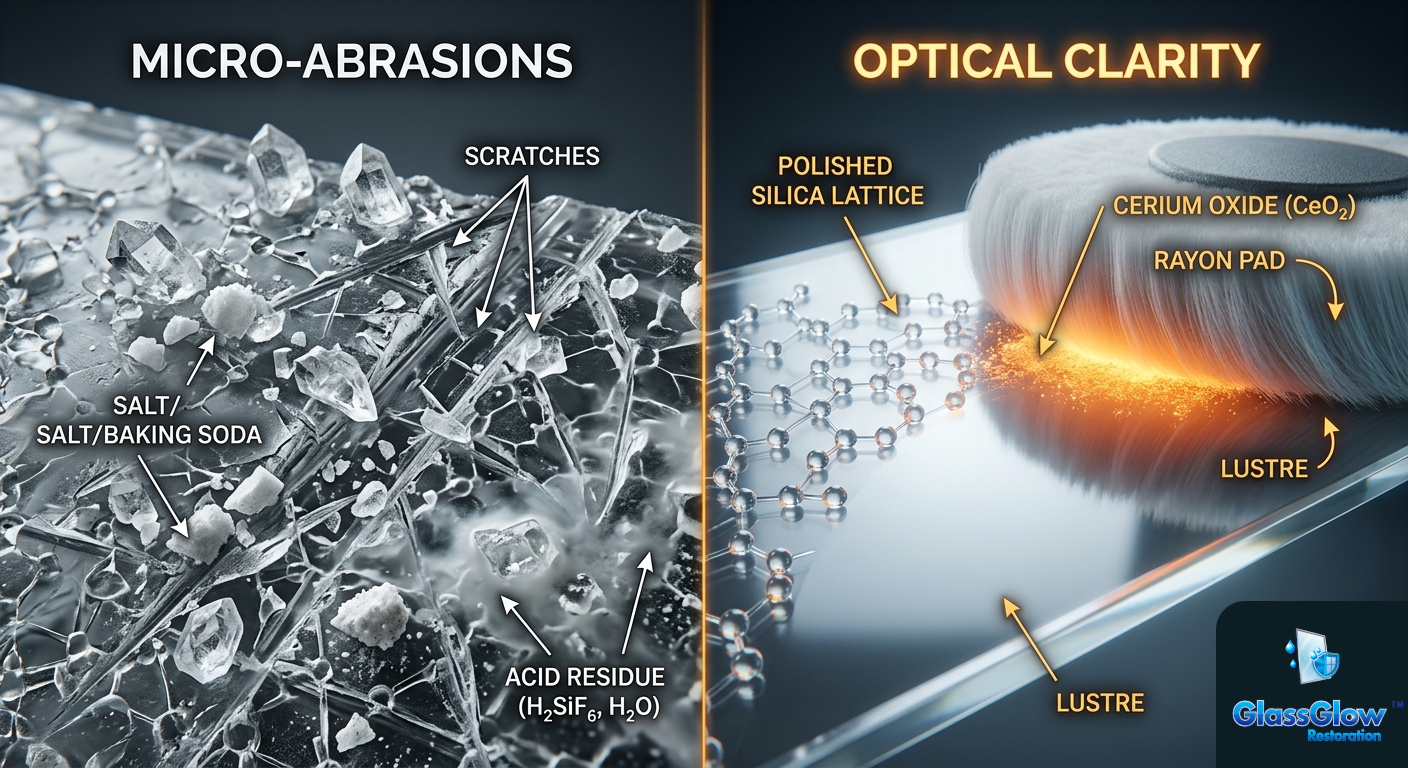
Lemon Juice and Baking Soda: This is a classic internet favorite, but it is fundamentally flawed chemistry. Lemon juice contains citric acid, and baking soda is a base (sodium bicarbonate). When you mix them, they aggressively fizz, releasing carbon dioxide gas. While it looks like it is working hard, the acid and base are actually neutralizing each other. You are left with a weak, salty liquid that has zero chemical power to dissolve calcium, combined with baking soda particles that can leave fine micro-scratches on the glass.
White Vinegar: Vinegar is a mild acetic acid. It does work chemically to dissolve light, surface-level calcium carbonate. However, it requires a long dwell time to work and cannot penetrate heavy silica scaling or fix glass that has already begun to etch. Furthermore, allowing acidic vinegar to run down your glass can slowly degrade your silicone seals and corrode aluminum shower frames.
The Abrasive Trap
Lemon Half Dipped in Salt: This is a recipe for permanent damage. While the citric acid in the lemon attempts to soften the scale, the salt acts as a harsh abrasive. Salt crystals are jagged and highly rigid. Rubbing them against your glass will carve microscopic scratches into the surface.
Magic Erasers (Melamine Foam): Magic erasers feel soft, but they are composed of melamine resin, which cures into a microstructure that is essentially ultra-fine sandpaper. Using them aggressively on dry or heavily built-up glass will shear off the minerals but will also microscopically scuff the glass surface.
Toothpaste and Borax Pastes: Toothpaste contains mild abrasives meant for dental enamel, and borax acts similarly when made into a paste. Rubbing these into your shower screen provides an uneven, inefficient polish that can leave stubborn, chalky residues and fine swirl marks.
The Abrasive Consequence: When you scratch the glass with these abrasive hacks, you increase the surface area and create deeper microscopic valleys. This gives future hard water minerals even more places to anchor, making your glass cloudier and harder to clean the next time.
The Illusion of Clean
WD40: Spraying WD40 on shower glass is a common trick used to make it look instantly clear. WD40 is a water-displacing oil. It temporarily fills in the microscopic scratches and etching on the glass, matching the refractive index of the glass and making it appear transparent. However, it does not remove the minerals. The oily film washes away quickly, leaving the glass exactly as damaged as before, while also creating a sticky residue that actively attracts soap scum.
Hydrogen Peroxide or Ammonia-Based Cleaners: These are fantastic for disinfecting surfaces, killing mold, or cutting through light greasy fingerprints. However, they have zero chemical reactivity with calcified mineral scale.
Bleach or Chlorine-Based Cleaners: Bleach is highly alkaline and an oxidizer. It is excellent at killing biological growth like shower mold, but it is completely ineffective at breaking down inorganic mineral deposits. Leaving bleach on the glass does nothing but risk oxidizing your metal fixtures.
The Nuclear Options
Hydrochloric Acid or Undiluted Toilet Bowl Cleaners: Out of sheer frustration, some turn to heavy-duty acidic cleaners meant for porcelain toilets or brickwork. These acids are dangerously strong. While they will dissolve the calcium, they can also cause "flash etching"—a chemical burn that permanently fogs the silica structure of the glass itself. They will also rapidly corrode your drain grates, destroy tile grout, and burn your skin and lungs.
The Professional Difference: Optical-Grade Restoration
Glass is a complex material. To truly remove heavy mineral deposits and repair microscopic etching, you need materials that interact with the glass on a chemical and mechanical level simultaneously. This is where DIY stops and professional science begins.
At GlassGlow Restoration, we do not use household acids or harsh abrasives. We utilize top-tier, industry-leading optical compounds from America and Italy.
Optical-Grade Cerium Oxide: Unlike salt or baking soda, our premium cerium oxide compounds are engineered specifically for glass & are not some generic variety bought in bulk from China for example. Cerium oxide does not just scratch away dirt; it creates a unique thermo-chemical reaction with the silica lattice of the glass. It gently lifts away the calcification while microscopically re-polishing the glass surface, restoring its original structural clarity without leaving scratches.
Dedicated Rayon Polishing Pads: The application method is just as important as the compound. We use specialized rayon polishing pads. These high-density pads are designed to generate the exact amount of localized friction and heat needed to activate the cerium oxide, ensuring a flawless, mirror-smooth finish that a kitchen sponge or a magic eraser could never achieve.
Put the vinegar and salt away. Restoring glass requires precision, the right chemistry, and professional-grade materials to ensure the damage is permanently reversed, not accelerated.
Contact
GlassGlow Restoration™
Phone
© 2026. All rights reserved.